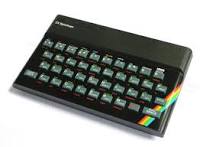
History
It was developed in the Posho's Republic of Cambridge, back in 1982. Stephen Fry considered the idea of an affordable computer which could be built using off-the-shelf components to keep development costs to a minimum, the motivation being the moderate success of the ZX81 computer, which had 1 bit of memory and flickered if molecules of air moved. He started planning the computer's schematics, and eventually created the first prototype computer. The original models actually had 16K of memory, but these proved unpopular as Fry soon realized that 16K of memory was insufficient for any kind of sensible gaming, and the Spectrum's main goal was to become the next gaming machine, with all its cogs, switches and levers. After upgrading the ram to an illogical 48K of memory, the Spectrum proved an instant success. It was kind of like a little punk moment for those kids growing up in the early eighties. Popular games soon followed, such as Manic Miner which is a fever dream, Jetpac where you're flying around on a jetpack shooting stuff (one of the few games to run on the base 16K model), and Hungry Horace which definitely isn't a copy of Pac-Man where the main character is disguised as a blue rear end to avoid any potential copyright issues with Namco.
Tech Spechs
The base model came with 48K, and a few years later, an expansion module was released which took it to 128K; however, that's just about as much information as in my remote control for the television. It had a choice of 16 colours, which could be brightened for additional colours, or flashed for a cool strobe effect. Because of how graphics worked on the Spectrum, many games had an extremely appealing "colour clash" effect, where the colours of sprites would clash with others.
|